Why Spanish Immersion Before Age 6 Is a Game Changer for Your Child
Why Spanish Immersion Before Age 6 Is a Game Changer for Your Child
As a parent, you want every advantage for your child. You research the best foods, the best activities, the best schools. But one of the most powerful gifts you can give your child before kindergarten doesn't come in a box or an app — it comes from immersing them in a second language while their brain is still in its most receptive state.
Here's what the research says — and why it matters for families in Salt Lake City.
The Critical Window: Ages 0–6
Linguists and neuroscientists agree: the years between birth and age six represent the most powerful language acquisition window in human development. During this period, children's brains are wired to absorb language naturally — without the effort, self-consciousness, or accent that adults experience when learning something new.
After age six, that window doesn't slam shut — but it does begin to narrow. Children who begin language immersion in preschool consistently achieve higher fluency levels than those who start in elementary school or later.
Bilingual Children Have a Cognitive Edge
The benefits of bilingualism go far beyond speaking two languages. Research consistently shows that bilingual children develop stronger executive function — the set of mental skills that includes focus, problem-solving, and the ability to switch between tasks. These are the same skills that predict academic success well into high school and beyond.
Bilingual children also tend to develop stronger empathy and cultural awareness — because navigating two languages naturally builds perspective-taking skills from an early age.
Immersion vs. Instruction: Why It Matters
There's an important distinction between language instruction and language immersion. Instruction teaches a child about a language — vocabulary lists, grammar rules, translation exercises.
Immersion allows a child to think, play, and live in a language, which is how the brain builds true fluency.
A child who hears Spanish only during a 20-minute class will not become bilingual. A child whose entire school day happens in a Spanish-rich environment will.
How Little Blooms Does It Differently
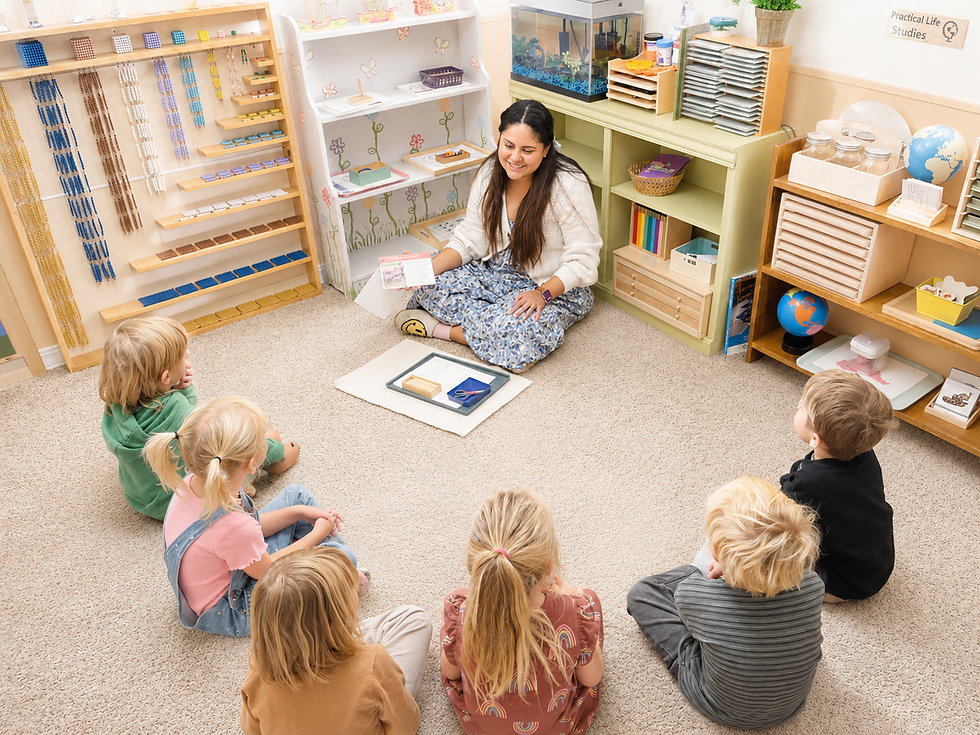
At Little Blooms Montessori in Sandy, Utah, Spanish is not a subject on the schedule — it is the environment. From the moment children arrive, Spanish is woven into greetings, instructions, materials, songs, and daily routines alongside English.
Combined with the Montessori method's emphasis on child-led, hands-on learning, our dual language immersion program creates an experience that is both academically rigorous and developmentally joyful. Children aren't studying Spanish — they're living it.
For families in Sandy, Draper, Midvale, and the greater Salt Lake valley, Little Blooms offers something genuinely rare: the combination of authentic Montessori education and true Spanish immersion, all within a warm, licensed, home-like setting.
The Best Time to Start Is Now
Every year that passes is a year inside that critical language window. If you've been curious about Spanish immersion for your child, the preschool years are not just a good time to start — they are the best time to start.
Enrollment at Little Blooms Montessori for the 2026–2027 school year is now open. We'd love to tell you more about our program and answer any questions your family has. Reach us at (801) 897-9393 or visit our Contact page to take the first step.


Comments